Ching-Mao Chang, M.D., Ph.D.
Director/Attending Physician (M.D.), Division of Integrative Medicine, Center for Traditional Medicine, Taipei Veterans General Hospital; Associate Professor, National Yang Ming Chiao Tung University.
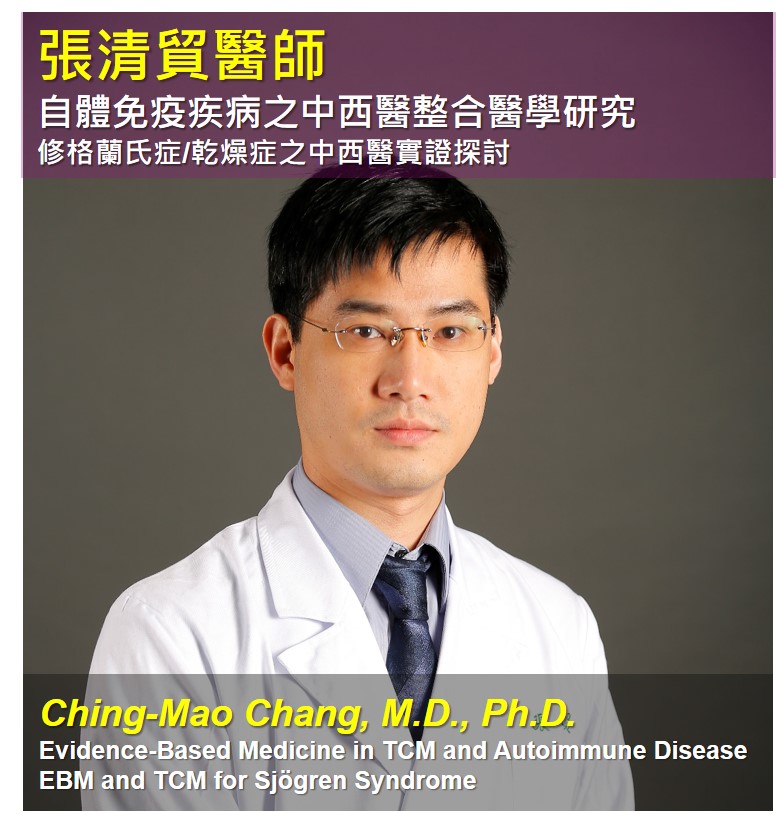
I am Ching-Mao Chang. I grew up in Taichung, attended St. Viator Catholic High School, and later entered the School of Chinese Medicine at China Medical University in Taichung, Taiwan. If I wanted to tell my story in an inspirational way, I could say that I had aspired from childhood to become a physician and dedicate myself to healing others. But if I am honest, that was not quite how it happened. As a young student, I was not someone who had firmly written, from the very beginning, “I will become a doctor of Chinese medicine.” My path was shaped more gradually—through the times I lived in, the educational system, personal interests, and the unfolding of life itself. Yet once I truly stepped into Chinese medicine, I began to realize that it was not a discipline one could approach superficially. The more I learned, the deeper it became; the deeper it became, the more reverence it inspired. Over time, I came to feel that this was a path worthy of being protected, practiced, and proven over the course of a lifetime.
After graduating from China Medical University, I went on to pursue both my master’s and doctoral degrees within the Chang Gung system. During my doctoral training, I also returned to the Department of Traditional Medicine at Taipei Veterans General Hospital for full clinical training, where I progressed from resident physician to chief resident and later attending physician. I now serve as Director of the Division of Integrative Medicine at Taipei Veterans General Hospital and as a faculty member at National Yang Ming Chiao Tung University. Throughout this journey, I have consistently stood at the intersection of clinical care, research, and teaching. Because of this, I have become increasingly convinced that if Chinese medicine remains only a collection of inherited experiences, it is not enough; if it remains only a body of theory preserved in books, it is still not enough. A truly powerful Chinese medicine must return to the patient, to the clinical setting, and to a place where it can be understood, validated, and genuinely needed in our time.
It was precisely out of this conviction that I founded the Autoimmune Disease and Dry Eye Syndrome Objective Measurements Lab (AIDDES Lab). I have long believed that if Chinese medicine is to truly enter contemporary medicine, it cannot rely solely on the elegance of its theories or the reputation of its clinical experience. It must also establish platforms that connect clinical observation, objective measurement, data analysis, and translational research. The creation of AIDDES Lab reflects this vision. Through it, we aim not only to observe symptoms in Sjögren’s syndrome, dry eye disease, and related autoimmune disorders, but also to measure, understand, and track these conditions in ways that can be communicated across both Chinese medicine and modern biomedicine. To me, AIDDES Lab is more than a laboratory; it is a practical commitment—to move Chinese medicine from experience toward evidence, from description toward quantification, and from individual insight toward a knowledge system that can be shared, examined, and carried forward.
I often joke that my family has practiced “Hundred generations of Chinese medicine—starting with mine.” It sounds humorous, but it also reflects how I view my own journey. I have never been particularly comfortable romanticizing my background or wrapping my life in unnecessary legend. I have always believed that a person’s worth does not necessarily lie in whether he or she is born into a preexisting tradition, but in whether he or she can begin from the ground up, walk a path with sincerity and substance, and eventually turn that path into something that others may continue. For me, Chinese medicine has never been a cultural symbol to decorate one’s identity; it is a discipline that requires real effort, real thinking, and real time.
Many people assume that I entered research simply because I particularly loved doing research. That is not entirely true. What truly pushed me forward was something simpler, and more stubborn: I wanted to understand Chinese medicine deeply—especially the Shanghan Lun (Treatise on Cold Damage). In my mind, the Shanghan Lun has never been merely an ancient classic to be memorized, cited, or tested. I have always seen it as an extraordinarily sophisticated clinical reasoning system: one that contains close observations of disease progression, sensitivity to the transformation of syndromes, rigorous coordination among theory, method, formula, and materia medica, and a profound understanding of the dynamic whole of human life. What makes it fascinating is not simply its antiquity, but its logic; not merely its formulas, but the complete and internally coherent knowledge system that lies behind them. I did not enter research simply to publish papers. I wanted to know: Why did the ancients think this way? Why did Zhang Zhongjing prescribe formulas in this manner? Why can the same ingredients produce entirely different therapeutic directions when only the dosage changes? I wanted to use modern methods to approach the deeper order and wisdom embedded in classical Chinese medicine.
Because of this, I have always maintained an attitude toward Chinese medicine that is both respectful and questioning. To me, Chinese medicine is not simply “anything that contains Chinese herbs,” nor is it beyond further inquiry simply because “it is written in the classics.” Its true essence lies in whether it can, under the guidance of Chinese medical theory, offer an appropriate understanding and response to a specific human being. Chinese medicine is not a discipline of standard answers, nor a game of matching disease names to prescriptions. It is a highly individualized form of medicine that emphasizes timing, wholeness, transformation, and the context of each person. It sees not only symptoms, but also the pattern of imbalance and the larger circumstances in which those symptoms arise. For this reason, I have always believed that Chinese medicine and modern science are not mutually exclusive paths. Chinese medicine has its own historical depth, cultural richness, and philosophical vision, while its therapeutic effects should also be subject to careful and rigorous evaluation. If a treatment truly benefits patients, then we have the responsibility to make that benefit clearer: to design better studies, establish stronger evidence, investigate deeper mechanisms, and help Chinese medicine become not only trusted, but also understood; not only inherited, but also recognized more broadly by the world.
Over time, I chose to focus my work on Sjögren’s syndrome, dry eye disease, and related immune-mediated conditions, precisely because these disorders are complex, chronic, and deeply burdensome to patients. In these conditions, Chinese medicine is often not merely “complementary”; it may offer a distinct way of understanding illness, caring for patients, and extending therapeutic possibilities. In the clinic, what I see are dryness, pain, fatigue, anxiety, helplessness, and the slow erosion of a person’s life by chronic illness. In research, the questions I ask are not merely whether something works, but why it works, for whom it works best, and how it can be made more precise, more objective, and more meaningfully connected back to the patient. I have always believed that good research does not turn patients into cold numbers. It begins with their suffering, passes through design, analysis, and verification, and ultimately returns to their improvement and hope. If research does not return to the human being, then even beautiful data remain incomplete.
I hold the same convictions in teaching. I do not want students to learn Chinese medicine merely as a matter of memorization, examination, or formula matching. What matters more to me is whether they learn to think; whether they can see the deeper structure of a clinical problem; whether they can read a paper not only for its results, but also for its limitations, assumptions, and silences. I often guide students through high-impact journals and intentionally ask them to read the accompanying editorials, because I believe one must never read only half a paper. To focus only on results is easy and flattering; to examine design, sources of bias, alternative perspectives, and unfinished questions is what helps a person truly mature. If I were to describe my teaching style, I would say that I hope students learn not only knowledge, but also judgment; not only how to answer questions, but also how to raise important ones; not only how to pass examinations, but how to become physicians capable of independent thought and genuine responsibility toward patients.
In clinical practice, I have come to believe even more deeply that medicine must have warmth. Chinese medicine has endured not simply because it has herbal formulas, acupuncture, meridians, and theories, but because from the very beginning it has dealt with the human being: the body, emotions, lived circumstances, imbalances, and the deep need to be understood, heard, and cared for. Some illnesses cannot be resolved by a single prescription. Some suffering is not truly addressed merely by normalizing a number. I often tell students that what many patients need is not only treatment, but understanding. When a person entrusts you with discomfort, fear, and uncertainty, that is itself a profound act of trust. If a patient is sincerely asking, I am willing to explain once, twice, or three times—until the person truly understands. Medicine is not a contest over who speaks fastest; it is a measure of who is willing to place the human being at the center.
I have also increasingly come to feel that Chinese medicine is not merely a medical technique; it is also a culture, and a way of seeing life. It reminds me that the human body is not a mechanical assembly of isolated organs, but a living whole in which everything is interconnected. Disease is not merely a local malfunction, but is often deeply related to lifestyle, emotion, constitution, environment, and the course of life itself. For that reason, I have always believed that Chinese medicine should not live only in the past, nor prove its value merely through nostalgia. It should enter the present, respond to today’s needs, accept the discipline of modern evaluation, and at the same time preserve its own depth, sensitivity, and holistic vision. It does not need to imitate others, nor should it close itself off. It must hold firmly to its roots while continuing to grow new branches, becoming a medicine that can truly speak to its era.
This path has not been easy. At times, studies have been submitted again and again only to be rejected. At times, clinical work and administrative duties have overlapped so heavily that even lunch became a luxury. At times, late at night, when others were already resting, I was still reading papers, revising manuscripts, and thinking about the next step. Yet I have always felt that it is worthwhile. Because when a treatment truly helps a patient, when a study genuinely reshapes how others understand Chinese medicine, or when a student finds direction through this process, then the long and often solitary labor is no longer merely hardship—it becomes meaningful.
My journey was neither one of predestined certainty nor one of smooth success. But perhaps because of that, I cherish every step forward more deeply. From Fengyuan in Taichung, into Chinese medicine, into research, into teaching, and again and again back to the patient, I have come to believe ever more firmly that medicine is not only technique, research is not only publication, and education is not only transmission. In the end, all of them point toward the same purpose: to understand human beings more honestly, to understand disease more deeply, and to safeguard life more thoughtfully—and in doing so, to help Chinese medicine become a path that can comfort patients, illuminate the present, and speak to the future.