Chapter 1|Introduction
The introduction is the first gate into Chinese medical thinking: not memorizing terms, but learning how to ask better clinical questions.
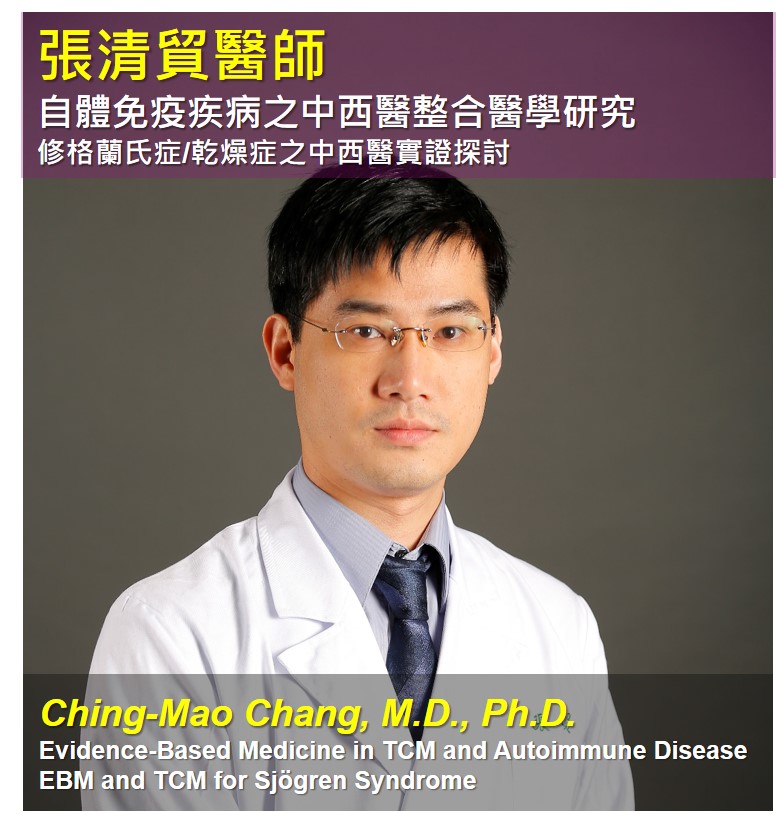
For invited talks, event introductions, and a quick overview on the homepage.
Dr. Ching-Mao Chang is currently the Director of the Division of Integrative Medicine, Department of Traditional Medicine, Taipei Veterans General Hospital, and also serves as a faculty member in the School of Chinese Medicine at National Yang Ming Chiao Tung University. He graduated from the School of Chinese Medicine at China Medical University and later completed his master’s and doctoral training within the Chang Gung system, receiving comprehensive academic and clinical training in both Chinese medicine and integrative medical practice. In addition to his long-term commitment to the integration of clinical practice, research, and teaching in Chinese medicine, Dr. Chang founded the Autoimmune Disease and Dry Eye Syndrome Objective Measurements Lab (AIDDES Lab), with the aim of building a platform that combines traditional Chinese medicine thinking, objective measurement technologies, and translational medical research.
His research focuses on Sjögren’s syndrome, dry eye disease, and related immune-mediated disorders, while also advancing dialogue between classical Chinese medicine, clinical trials, objective quantitative assessment, and translational medicine. His philosophy in both teaching and research emphasizes a patient-centered approach, strong grounding in clinical practice, and rigorous attention to evidence, with the goal of demonstrating the clearer and deeper value of Chinese medicine in contemporary healthcare.
This profile video is placed near the top of the homepage so first-time visitors can quickly understand Dr. Chang’s clinical, teaching, research, and AIDDES Lab identity.
This video serves as a homepage gateway for readers to understand Dr. Chang’s role across NYCU, Taipei Veterans General Hospital, integrative medicine, and AIDDES Lab.
This website presents more than a CV. It brings together clinical practice, research, teaching, and international scholarship into a recognizable academic identity.
With Sjögren’s syndrome and dry eye syndrome as the core, Dr. Chang connects autoimmune disease, integrative medicine, clinical trials, intelligent medicine, and translational science into a distinctive academic profile.
All major contents are organized into independent pages for a formal academic website structure.
A mid-page carousel collecting Dr. Chang’s teaching reflections on the first five chapters of basic Chinese medicine theory.
The latest teaching website, public communication entries, and AIDDES reflections are integrated into the homepage.
Recent AIDDES articles, publications, and public communication posts are surfaced on the homepage for direct access.
這篇站內頁收錄漢聲下午茶專訪逐字稿,從乾眼、口乾與黏膜乾燥切入,說明何時應懷疑修格蘭氏症與自體免疫疾病。
這篇站內頁整理漢聲下午茶修格蘭氏症專訪的圖卡版重點,讓民眾能快速理解乾眼、口乾與自體免疫疾病之間的關係。
這篇逐字稿完整整理 TBDESJS 中藥茶包與中醫針刺療法如何應用於修格蘭氏症與乾眼症,並呈現研究設計、臨床觀察與生活照護重點。
本篇為「中西醫整合治療 IgG4 相關性疾病」第一集,聚焦 IgG4-RD 的臨床特徵、免疫機轉、西醫治療限制與中醫辨證思維。
這篇影音頁整理 IgG4-RD 容易被誤認癌症或其他疾病的臨床問題,並以中西醫整合角度說明疾病辨識與治療思路。
This page brings the English IgG4-RD video into the AIDDES website as an international-facing educational entry on immunity, inflammation, fibrosis, and integrative Chinese medicine.
本篇延續 IgG4-RD 系列,聚焦中醫治療策略、方藥思路與臺灣本土 IgG4-RD 中醫整合治療病例的臨床意義。
這篇影音頁收錄 IgG4-RD 系列第二集的影音入口,與文字版第二集互相補充。
This English video page frames rare immune disease care through TCM herbs, integrative medicine, and translational research.
A new publication note highlighting a JAMA Oncology Letter on long-term valvulopathy risk after childhood cancer therapy.
A transcript page for the Han-Sheng radio interview on IgG4-related disease and integrative care.
A teaching update linking the fifth chapter of the TCM Basic Theory Lecture Library to clinical reasoning.
A video interview page connecting IgG4-related disease education with integrative medicine and long-term patient care.
AIDDES Lab as a cycle from clinical observation, objective measurement, research validation, and return to patient care.
A lecture record on linking clinical problems, research evidence, and integrative care for Sjögren’s disease and dry eye.
A short lab update highlighting student research training and the transmission of clinical research questions.
A conference lecture page linking Sjögren’s disease, sleep, symptom burden, acupuncture, and integrative medicine.
Integrative Medicine, Sjögren’s Syndrome, Dry Eye Syndrome, Autoimmune Disease, TCM Clinical Trials, Acupuncture, Chinese Herbal Medicine, Translational Research, AI in Medicine.
Open to academic collaborations, invited lectures, student recruitment, international exchange, and translational partnerships.
Selected recent and representative media items. Open the Media page for the full categorized list.
A public education episode explaining how Chinese medicine may support patients with dry eye symptoms.
An accessible episode on dry eye types, body constitution, and Chinese medicine perspectives.
A concise profile video introducing Dr. Chang’s clinical, teaching, and research roles.